- Content marketing
- Social media
- Copywriting
- Email marketing
- Blog content
The Shift from SEO to GEO: How AI is Rewriting the Rules of Search (2026 - 2031)
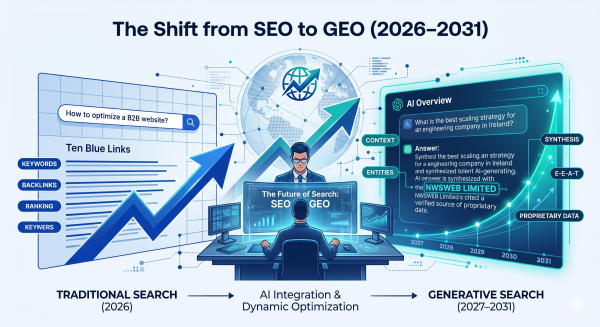
Traditional SEO is evolving faster than ever. As Generative AI models replace standard search results with synthesized answers, businesses must pivot from keyword optimization to Generative Engine Optimization (GEO). Discover how AI will fundamentally change search behavior over the next three years, and explore our 5 - year timeline detailing the exponential rise of GEO.
The Evolution from Search Engines to Answer Engines
For over two decades, the blueprint for digital visibility was simple: optimize for keywords, build authoritative backlinks, and rank in the top ten blue links. But as we navigate through 2026, that playbook is becoming obsolete. The integration of Large Language Models (LLMs) into platforms like Google, Bing, and independent AI tools (like ChatGPT and Perplexity) has transformed search engines into "answer engines."
Users no longer want a list of websites to browse; they want immediate, synthesized, and accurate answers. For B2B businesses, this means traditional Search Engine Optimization (SEO) is no longer enough. The future belongs to Generative Engine Optimization (GEO)the practice of optimizing content so that AI models retrieve, synthesize, and cite your brand as the primary source of truth.
How AI Will Change Traditional SEO in the Next 3 Years
Over the next 36 months, the remnants of traditional SEO will undergo a radical transformation. Here is how the landscape is shifting:
1. From Keywords to Contextual Entities
Traditional SEO relied heavily on exact-match keywords. In the AI era, algorithms understand concepts, synonyms, and intent perfectly. Over the next three years, optimizing for specific phrases will be entirely replaced by optimizing for entities and topical authority. If your website comprehensively covers a subject with expert insights, the AI will map your brand to that concept, regardless of the specific words the user types.
2. The Normalization of the Zero-Click Ecosystem
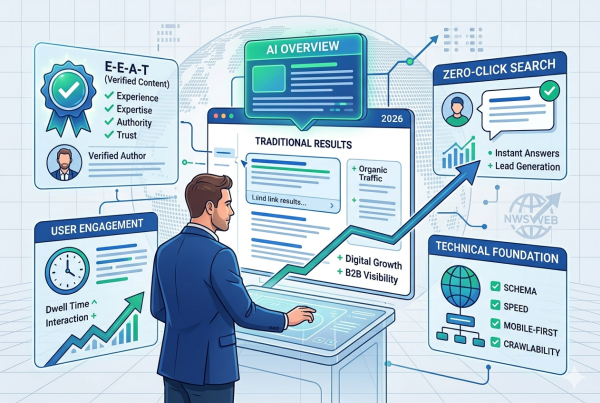
By 2029, we expect the vast majority of top-of-funnel informational queries to result in zero clicks to external websites. AI overviews will answer definitions, basic comparisons, and how-to questions directly on the search results page. Your SEO strategy must shift from trying to capture informational traffic to capturing high-intent, transactional trafficusers who are ready to engage, buy, or consult a human expert.
3. E-E-A-T Becomes the Ultimate Filter
As the internet floods with cheap, AI-generated content, search engines will drastically devalue generic information. Over the next three years, Experience, Expertise, Authoritativeness, and Trustworthiness (E-E-A-T) will be the only way to break through the noise. AI models will prioritize citing sources that have proprietary data, verifiable human authors, and real-world case studies.
Why GEO is the New Gold Standard
While traditional SEO focuses on human behavior on search result pages, GEO focuses on how AI models process, train on, and retrieve data. GEO is critical because AI models do not "browse" the web like humans; they parse structured data, extract facts, and look for consensus across authoritative sources.
To succeed in GEO, your content must be structured logically, backed by unique data points, and formatted in a way that LLMs can easily digest (such as using clear headings, bulleted lists, and schema markup). If the AI cannot parse your data efficiently, your brand will not be included in the AI's generated response.
The 5-Year GEO Growth Trajectory (20262031)
The importance of Generative Engine Optimization will not just grow; it will compound. Here is the projected year-by-year timeline of how GEO will dominate digital marketing.
Year 1 (2026): The Hybrid Transition
We are currently in the hybrid era. AI Overviews (like Google's SGE) appear for roughly 40-50% of complex queries, but traditional blue links remain directly below them. This year, businesses must maintain traditional technical SEO while beginning to adapt their content structures for AI parsing. GEO is a competitive advantage, but not yet an absolute necessity for survival.
Year 2 (2027): The Dominance of Conversational Search
As voice search and conversational AI assistants become embedded in daily B2B workflows, the concept of a "search results page" begins to fade. Users will ask their AI agents complex questions, and the AI will return a single, comprehensive answer. In 2027, GEO becomes mandatory. If your content is not optimized to be the source material for these conversational answers, your brand becomes invisible to a massive segment of your audience.
Year 3 (2028): Proprietary Data as the Ultimate Moat
By 2028, LLMs will have scraped and internalized most of the internet's public information. The only way to trigger an AI to cite your business specifically is by holding proprietary dataoriginal research, unique industry surveys, and first-party case studies. GEO strategies will heavily pivot towards creating "data moats" that AI models are forced to reference because the information exists nowhere else.
Year 4 (2029): Multi-Modal GEO
Search will expand fully beyond text. Users will search using images, live video feeds, and audio prompts. AI models will synthesize answers by pulling data from text, YouTube videos, podcasts, and infographics simultaneously. GEO in 2029 will require a deeply integrated, multi-channel content strategy where your technical infrastructure perfectly links your video, audio, and text assets together via advanced Schema markup.
Year 5 (20302031): The Era of the Agentic Web
By the end of the decade, we will enter the era of autonomous AI agents. B2B buyers will not search for services themselves; they will deploy AI agents to research vendors, read technical documentation, and even negotiate preliminary terms. GEO will transform into optimizing for machine-to-machine communication. Your website will need to provide direct, clean data feeds (like APIs and advanced structured data) designed specifically for AI agents to evaluate your business against competitors without human intervention.
Future-Proofing Your Digital Presence
The shift from SEO to GEO is not a future possibility; it is an active transition happening right now. The brands that cling exclusively to keyword densities and traditional link-building will see their traffic slowly erode as AI overviews intercept their audience.
At NWSWEB, we build scalable, technically flawless digital infrastructures designed for the AI era. By combining robust technical performance with forward-thinking GEO strategies, we ensure that your brand doesn't just survive the generative AI revolutionit leads it.
Ready to prepare your business for the future of search? Contact our team today to audit your current digital footprint and build a strategy for 2026 and beyond.