- Content marketing
- Social media
- Copywriting
- Email marketing
- Blog content
David vs. Goliath: How SME B2B Brands Can Outrank Industry Giants in Local Search
Trying to outspend multinational corporations on broad search terms is a fast track to draining your marketing budget. But there is a smarter way to win. By combining hyper-local SEO, deep business strategy, and flawless technical foundations, agile small businesses can completely dominate high-converting local searches. Here is the exact blueprint to beat the giants in the 2026 digital landscape.
The Broad Keyword Trap (Or: Stop Setting Your Budget on Fire)
Lets paint a familiar picture. You run a highly specialized B2B service in Ireland, and you want to rank number one on Google for "software development" or "B2B accounting." The problem? You are stepping into an arena where enterprise giants with bottomless marketing budgets have already bought all the front-row seats.
The economic reality of the 2026 search ecosystem is brutal for broad keywords. High-level B2B terms regularly command Cost-Per-Click (CPC) rates of 15 to 50. Worse still, the intent behind these broad searches is incredibly vague. A user searching for "logistics" could be a college student researching an essay, not a procurement manager ready to sign a 50,000 contract.
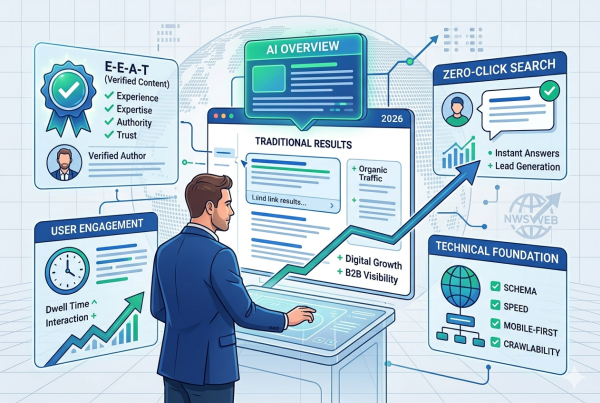
Add generative AI to the mix, and the situation gets even tougher. AI overviews are now answering basic, broad questions directly on the search results page. If you are pouring your budget into ranking for generic informational terms, you are fighting a losing battle for traffic that will likely never convert.
The Hyper-Local Goldmine: Quality Over Quantity
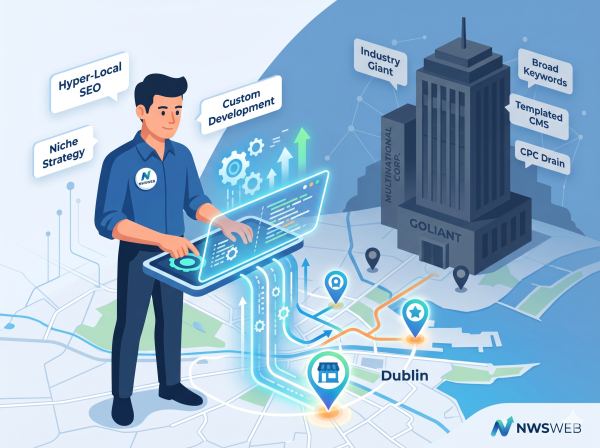
So, how does David beat Goliath? He doesn't fight him head-on. He changes the battlefield.
The antidote to the broad keyword trap is a relentless focus on niche, hyper-local search intent. Instead of fighting a global war for "inventory software," you target exactly what your ideal client is typing: "custom inventory software for Dublin retail."
Yes, the broad term might get 10,000 searches a month, while your hyper-local term only gets 50. But here is the secret: those 50 searches have immediate, bottom-of-the-funnel commercial intent. A keyword with 50 searches that converts at 10% generates substantially more qualified pipeline revenue than a broad term with massive volume that converts at 0.1%.
In Ireland, proximity matters. B2B decision-makers inherently prefer local, accessible partners they can trust. When you dominate the local search results for your specific niche, you aren't just getting traffic; you are capturing buyers who are actively looking to hire someone in their time zone, today.
Keyword Selection is a Business Strategy, Not a Marketing Task
Here is where most SME strategies fall apart: they treat SEO as a quick, entry-level marketing task. In reality, identifying the right hyper-local keywords is a profound business decision.
To find the semantic footprint that will actually drive revenue, you need a rare blend of advanced technical SEO knowledge and deep business acumen. You cannot simply guess what your customers are searching for. You need to analyze sales calls, understand your unit economics, and align your digital strategy with your actual operational strengths.
Getting this initial planning phase wrong carries severe consequences. You could waste months of effort and thousands of euros ranking for terms that look great on a graph but deliver zero actual pipeline revenue.
This is why achieving local dominance requires a collaborative, 6 to 12-month roadmap. It is a partnership between your business experts and your technical team to track data, analyze real-world buyer behavior, and continuously refine the strategy. SEO is not a "set it and forget it" task; it is the joint engineering of your long-term business growth.
The Technical Foundation: Speed is Revenue
You can have the best local strategy in the world, but if your websites underlying architecture is flawed, both Google and AI engines will ignore you.
In 2026, technical perfection is the strict prerequisite for entry into local search. Search algorithms demand flawless machine-readability and instant data retrieval. This boils down to two critical elements:
- Core Web Vitals: If your site feels sluggish or jumpy, you are actively losing money. Empirical data shows that every 100 milliseconds of load delay reduces conversion rates by 7%. You need sub-second load times to keep B2B buyers engaged.
- Advanced Schema Markup: This is the secret language of AI. By injecting deeply nested, highly specific LocalBusiness and Service structured data into your code, you tell the AI exactly who you are, what you do, and where you are located. This is how you guarantee your SME is the one cited when a buyer asks an AI assistant for a local vendor recommendation.
Why Off-the-Shelf Templates Will Break Your Strategy
This level of technical rigor exposes a massive vulnerability for most SMEs: they are running on legacy, template-based systems like traditional WordPress setups.
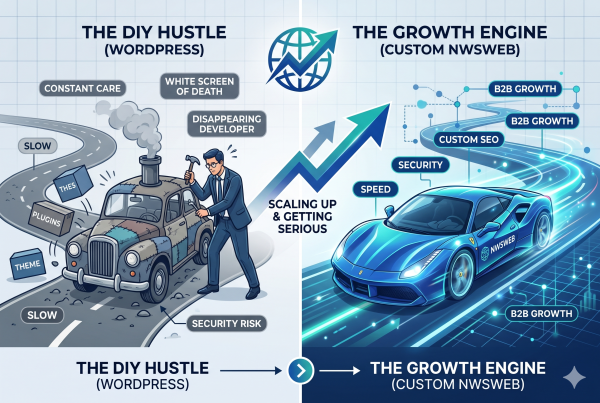
Trying to achieve sub-second load times and complex data structures on a monolithic CMS packed with 30 third-party plugins is like trying to win a Formula 1 race in a tractor. The plugin bloat causes synchronous server delays, constant security vulnerabilities, and ultimately, a failing grade on Google's performance metrics.
To secure a durable competitive advantage, you need a custom-built infrastructure. While cheap templates seem appealing on day one, the Total Cost of Ownership (TCO) of maintaining, patching, and fixing a broken site far exceeds the cost of doing it right the first time.
At NWSWEB, we build modern, decoupled web architectures that deliver the lightning-fast speeds and iron-clad security required for modern SEO. We provide the agile, custom foundation that empowers your business to deploy local campaigns rapidly, without the fear of your website breaking.
Ready to stop fighting Goliath on his terms and start dominating your local market?
Let's discuss your project and build a tailored 12-month growth strategy for your business.
Interactive Data: The Economics of Local B2B Search (2026)
Source: 2026 Irish B2B Search Ecosystem Deep Research Study
Read the Full Raw Data: 2026 SME Local Search Deep Research Study
Deep Research Study: How Small B2B Businesses Can Outrank Industry Giants in Local Search
Executive Summary
The 2026 digital ecosystem in Ireland presents an increasingly hostile and asymmetrical environment for Small and Medium Enterprises (SMEs) relying on legacy search marketing architectures. A fundamental paradigm shift has occurred, driven by the rapid maturation of generative artificial intelligence and the restructuring of search engine results pages. Traditional strategies that prioritize broad keyword targeting and generic content production are no longer viable against enterprise organizations with vastly superior capital resources and entrenched domain authority. For an Irish SME, attempting to outrank multinational corporations on high-volume, generic queriessuch as "software development" or "B2B accounting"results in rapid budget depletion and severely diminishing returns.
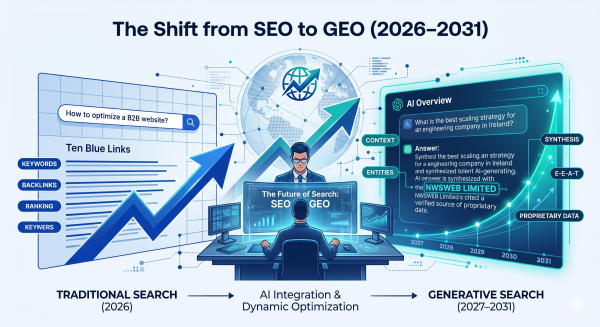
The underlying catalyst for this disruption is the accelerated adoption of AI-powered search engines. By 2025, 91% of Irish internet users were actively engaging with AI-powered tools, a dramatic increase from 49% the previous year. Consequently, traditional search engine volume is projected to drop by 25% by 2026, an event characterized by analysts as the "25% traffic cliff". This structural decline means that broad informational queries, which once drove substantial top-of-funnel traffic, are now synthesized directly on the search interface via AI Overviews, satisfying user intent without necessitating a website visit.
To survive and outmaneuver industry giants, SMEs must execute a highly disciplined, hyper-local, and technically flawless SEO strategy. The competitive moat for a smaller B2B organization lies in capturing high-intent, low-volume long-tail keywords deeply tied to local geography and specific business solutions. While these queries yield lower aggregate search volumes, they convert at exponentially higher rates due to their immediate commercial intent and relevance to the regional buyer.
This pivot requires significantly more than surface-level marketing adjustments; it demands deep strategic alignment between technical infrastructure, financial forecasting, and operational business acumen. Local search dominance in 2026 is predicated on flawless technical foundationsspecifically, perfect Core Web Vitals scores and advanced, nested Schema markup that acts as a direct, machine-readable data feed for Large Language Models. Furthermore, the technical debt associated with legacy, template-based Content Management Systems severely hinders the agility, security, and rendering speed required for modern visibility. Transitioning to custom-built or headless infrastructures is no longer an enterprise luxury but a strict operational necessity for SMEs aiming to ensure the rapid load times and clean semantic code that AI engines prioritize.
This research report provides an exhaustive, data-backed foundation detailing the precise technical, strategic, and infrastructural requirements necessary for Irish B2B SMEs to outrank global giants, capture highly qualified local pipelines, and secure dominant visibility in an AI-mediated search landscape.
Key Statistics and Facts
The following data sets establish the quantitative foundation for the strategic recommendations contained within this report. The statistics reflect the realities of the 2026 search landscape, specifically focusing on the intersection of AI adoption, local search intent, financial conversion benchmarks, and technical performance parameters.
Market Dynamics and the AI Search Paradigm
The transition from traditional hyperlink-based results to generative answer engines has fundamentally altered traffic distribution. The data indicates that visibility no longer equates directly to website traffic, necessitating a paradigm shift in how SMEs measure digital acquisition.
| Metric | 2026 Data Point | Context & Strategic Implication |
|---|---|---|
| Traditional Search Volume Decline | 25% projected drop | Known macroeconomically as the "25% traffic cliff," AI engines are absorbing queries that previously drove clicks to websites, severely impacting lead generation for local service providers who rely on top-of-funnel discovery. |
| Irish AI Tool Adoption | 91% of internet users | A near-total transformation in digital behavior occurred within a single year (up from 49% in 2024), indicating that Irish B2B buyers now default to synthesized, conversational answers rather than manual browsing. |
| Zero-Click Search Rate | 68% - 72% | Across all Google queries, the majority resolve without a click. For informational queries, this rises to 75-80%, rendering top-of-funnel informational content increasingly obsolete for direct traffic acquisition. |
| AI Overview Organic CTR Impact | 61% decline | The presence of an AI Overview reduces traditional organic click-through rates significantly, pushing the value toward transactional, hyper-local, and highly specialized long-tail queries where AI struggles to provide definitive local vendor recommendations. |
| AI Citation Source Ranking Correlation | 38% from Top 10 | Only 38% of pages cited in AI Overviews rank in the top 10 traditional organic results, down from 76% in 2025. This establishes that entity authority, brand mentions, and structured data are overriding traditional ranking signals. |
The macroeconomic shift depicted in the data above illustrates a terminal decline for traditional, broad-spectrum content marketing. Because 73% of B2B buyers now utilize AI tools in their purchase research, securing a presence in these localized, highly specific AI outputs is paramount. The 61% decline in organic click-through rates for informational queries means that B2B organizations can no longer rely on educational blog posts to drive top-of-funnel awareness. Instead, the strategy must pivot toward optimizing for "Share of Model"a metric defined by how frequently a brand is cited by Large Language Models during specific, localized procurement queries. The fact that only 38% of AI citations originate from the top 10 organic search results is a critical revelation; it proves that smaller enterprises can leapfrog larger competitors in AI recommendations by utilizing superior structured data and hyper-specific entity signals, even if they lack the domain authority to rank number one in traditional search.
Financial Benchmarks: Broad Paid Acquisition vs. Local Organic
The economic disparity between broad keyword targeting and highly specific, long-tail local targeting demonstrates why SMEs cannot engage in financial attrition wars with enterprise competitors.
| Metric | 2026 Data Point | Context & Strategic Implication |
|---|---|---|
| B2B SaaS Cost-Per-Click (CPC) | $5.00 $20.00+ | Highly competitive broad terms command exorbitant CPCs. Legal and professional services can exceed $30.00 to $50.00 per click, rapidly depleting SME budgets without guaranteed conversions. |
| Organic vs. Paid B2B CPL | $164 vs. $310 | For B2B SaaS, organic lead acquisition yields a 47% cost saving compared to paid channels. High-intent SEO investments produce compounding returns that paid media cannot replicate over a multi-year horizon. |
| Irish Local SEO Campaign Cost | 1,500 3,500 / month | A competitive local or county-level SEO campaign in Ireland requires a fraction of the budget of a national enterprise campaign (10,000+/month), making local dominance highly capital-efficient for SMEs. |
| 3-Year SEO ROI (B2B SaaS) | 702% | Despite requiring 6 to 12 months to break even, a disciplined B2B SEO strategy prioritizing long-tail keywords delivers an average ROI of 702% over a three-year horizon. |
The financial data highlights a phenomenon identified by industry analysts as "quality inflation". Over the past 24 months, the deprecation of third-party cookies, stricter GDPR enforcement in the EU, and iOS privacy updates have severely limited audience targeting granularity for paid advertisements. Consequently, B2B companies are forced to bid on the same high-intent broad keywords, driving auction prices to unsustainable levels. An Irish SME spending 3,000 per month on Google Ads might only acquire a handful of clicks if targeting broad terms like "commercial property solicitor," and without rigorous negative keyword management, a substantial portion of that budget is wasted on irrelevant searches. Conversely, organic acquisition via localized SEO represents a compounding asset. While the break-even point for B2B organic search sits between 7 and 13 months depending on the sector, the long-term cost per acquisition plummets, resulting in an average three-year ROI of over 700%.
Conversion and Technical Performance Constraints
The underlying architecture of a website directly dictates its ability to compete in both traditional local SEO and AI-driven discovery. The performance gap between legacy systems and modern frameworks is expanding.
| Metric | 2026 Data Point | Context & Strategic Implication |
|---|---|---|
| PageSpeed Insights Score (Next.js) | 85 - 100 (Median 94) | Modern headless architectures deliver sub-second load times, directly satisfying Google's stringent Core Web Vitals requirements out-of-the-box via static generation and edge delivery. |
| PageSpeed Insights Score (WordPress) | 45 - 75 (Median 58) | Standard monolithic CMS instances suffer from plugin bloat and synchronous server rendering delays, typically resulting in 3 to 5-second load times and failing Core Web Vitals thresholds. |
| Conversion Drop per 100ms Delay | 7% reduction | Every 100 milliseconds of page load delay reduces conversion rates by 7%. Technical speed is not merely an algorithmic ranking factor; it is a critical commercial revenue optimization metric. |
| AI Citation Probability by Position | Position #1: 33.07% | The probability of an AI engine citing a business drops by 60% (down to 13.04%) if the entity falls to position 10. Achieving peak technical and content authority remains mandatory for AI visibility. |
| Local Search Conversion Proximity | 76% within 24 hours | 76% of users conducting a local search visit or contact a business within 24 hours. Local queries possess immediate commercial intent, unlike broad educational searches. |
Technical performance metrics explicitly demonstrate that website infrastructure is a primary driver of commercial success. The 7% reduction in conversion rate per 100-millisecond delay underscores the hidden cost of legacy web development. When a B2B buyer, typically part of an 11.2-person buying committee, encounters a slow, unresponsive website, brand trust immediately erodes. Furthermore, the correlation between technical speed, traditional ranking, and AI citation probability illustrates a compounding algorithmic advantage for fast, well-structured sites. A website built on a modern framework that scores in the 90s on PageSpeed Insights is parsed and indexed exponentially faster by search engine crawlers, allowing its structured data to feed into the AI ecosystem with maximum efficiency.
Chapter 1: The "David vs Goliath" Search Reality
Chapter Outline: Technical and Strategic Points
- The Broad Keyword Trap: Analysis of why generic head terms function as financial sinks for SMEs.
- The Economics of CPC Inflation: Examination of enterprise auction dominance and quality inflation in B2B paid media.
- The 25% Traffic Cliff and AI Overviews: How generative AI disproportionately harms broad informational visibility.
- Share of Model vs. Share of Voice: The strategic pivot from chasing vanity traffic to securing citations within Large Language Models.
Research Analysis and Narrative
The foundational error committed by the majority of B2B SMEs is attempting to compete symmetrically against enterprise organizations. In the 2026 search ecosystem, targeting broad, globally relevant keywords such as "CRM software," "marketing consultant," or "logistics provider" is mathematically unviable for a business with limited capital. Multinational corporations possess marketing budgets that eclipse the total gross revenue of typical SMEs, allowing them to dominate organic search results through sheer domain authority, massive backlink profiles, and the ability to outspend all competitors in paid search auctions.
The economic realities of the Google Ads auction system explicitly favor the enterprise. The average Cost-Per-Click for competitive B2B SaaS keywords currently ranges from $5.00 to $20.00, while high-value sectors such as legal, financial, and professional services frequently see costs exceeding $30.00 to $50.00 per click. At these rates, a small Irish enterprise attempting to buy visibility on broad terms will exhaust its budget rapidly. Furthermore, broad keywords suffer from a severe intent mismatch. A user searching for "software development" may be an undergraduate student seeking a definition, a junior developer looking for a tutorial, or a competitor analyzing the market. Because the intent is ambiguous, the SME pays a premium price for clicks that possess zero probability of converting into a qualified sales pipeline.
Compounding this issue is the phenomenon of "quality inflation" within B2B acquisition channels. Privacy regulations, the deprecation of third-party cookies, and stringent GDPR enforcement in Europe have severely degraded the granular targeting capabilities of major advertising platforms. Without the ability to precisely target specific buyer personas, ad algorithms default to broader audience matching. To counteract this loss of precision, B2B companies are forced to bid hyper-aggressively on the few remaining high-intent keywords, driving auction prices up artificially. B2B teams report that high-intent attention is increasingly scarce and expensive, leading to a scenario where businesses are paying significantly more to reach fewer, albeit better-qualified, buyers. The SME cannot sustain this model of quality inflation against an enterprise competitor with a massive Customer Lifetime Value margin.
Simultaneously, the organic value of broad keywords has been decimated by the advent of AI Overviews and answer engines. As of 2026, the digital landscape is navigating the "25% traffic cliff," a stark reality where traditional search engine query volume is dropping precipitously as Large Language Models absorb and synthesize informational searches directly on the results page. With 91% of Irish internet users actively engaging with AI tools, the consumer expectation has shifted fundamentally. Users no longer expect to click through multiple blue links to aggregate data; they expect an immediate, conversational answer. For B2B informational queries, zero-click searches now account for 75% to 80% of total search volume. When Google triggers an AI Overview, organic click-through rates plummet by an average of 61%. Therefore, an SME could theoretically invest heavily to reach page one for a broad informational term, only to receive zero traffic because the AI satisfied the user's intent immediately.
To survive this "David vs Goliath" reality, SMEs must abandon the pursuit of raw traffic volume and traditional Share of Voice. The new competitive metric is "Share of Model", which measures how frequently a brand appears as a cited, trusted entity within AI-generated responses. Because 73% of B2B buyers now utilize AI tools in their purchase research, securing a presence in these localized, highly specific AI outputs is paramount. SMEs must engineer their digital footprint not to compete on broad keyword matching against multinationals, but to establish unassailable "entity authority" in highly defined, niche, and localized semantic clusters where AI models require deep, specific data to function.
Chapter 2: The Power of Niche & Hyper-Local SEO
Chapter Outline: Technical and Strategic Points
- The Mechanics of High-Intent Long-Tail Queries: Defining the structural advantage of highly specific search phrases.
- Conversion Superiority over Search Volume: Statistical evidence that low-volume local searches yield exponentially higher commercial returns.
- Proximity and Regional Buying Behavior: The influence of geography on B2B procurement and decision-making in the Irish market.
- Capital Efficiency of Local SEO: Cost comparisons between regional dominance and national visibility.
Research Analysis and Narrative
The strategic antidote to the broad keyword trap is a relentless, uncompromising focus on niche, hyper-local SEO. Instead of targeting a generic head term like "inventory software," an SME must optimize for high-intent, long-tail geographical variants such as "custom inventory software for Dublin retail." While the broad term may boast tens of thousands of monthly searches, the long-tail local term may only register 50 searches per month. However, the commercial reality of B2B search renders the broad volume entirely irrelevant to the bottom line. A broad keyword attracts a vast array of unqualified traffic, resulting in conversion rates that typically hover near 0.1%. Conversely, a user typing a highly specific, localized query possesses immediate, bottom-of-the-funnel commercial intent. A keyword with 50 searches that converts at 10% generates substantially more qualified pipeline revenue than a broad term with massive volume that never yields a sales lead.
The mechanical advantage of long-tail local SEO lies in the exact matching of specific buyer pain points. Generic keywords attract broad, untargeted traffic; long-tail keywords position the SME exactly where the customer's immediate need resides. Furthermore, search engine algorithmsand the AI systems that parse themreward highly relevant, specialized content. By explicitly addressing specific local queries, the SME reduces bounce rates, increases dwell time, and signals deep topical authority to the algorithm, which in turn accelerates ranking velocity.
The power of local SEO is heavily amplified by deep-rooted Irish buyer behaviors. Research indicates that 46% of all Google searches carry local intent, and 76% of individuals conducting a local search act upon it within 24 hours. In Ireland specifically, geographic proximity exerts a profound influence on commercial relationships. Mobility data reveals that 93.2% of Irish consumers travel no more than 20 minutes for everyday purchases. While complex B2B software and service procurement is not strictly bound by physical travel constraints, this statistic acts as a powerful sociological proxy for the inherent Irish preference for local, accessible, and highly accountable business partnerships. Irish decision-makers place a premium on vendor proximity for relationship building, localized support, cultural alignment, and face-to-face account management. Therefore, appearing prominently in location-based searches within an immediate regional catchment area allows an SME to capture a highly predisposed audience that inherently prefers not to contract with faceless global entities.
From a capital allocation perspective, hyper-local SEO provides an asymmetrical advantage, transforming the SME's smaller budget into a strategic weapon. Competing for national or international B2B terms requires enterprise-level monthly retainers, often exceeding 10,000 per month just to maintain visibility against algorithmic volatility and competitor spending. In stark contrast, dominating a local or county-level B2B market in Ireland (e.g., targeting specific commercial zones in Galway, Cork, or specific Dublin suburbs) requires a significantly leaner investment, typically ranging from 1,500 to 3,500 per month. This budget effectively covers deep technical architecture fixes, the generation of highly specific service pages, the deployment of suburb-specific landing pages, and the rigorous management of Google Business Profiles and local citations.
Because the density of competition at the hyper-local level is significantly thinner, SMEs can achieve total market saturation relatively quickly if they execute flawlessly. By saturating the local search environmentaccumulating localized reviews, leveraging precise geographic schema markup, and structuring website content to address region-specific business problemsthe SME effectively builds an impenetrable digital wall around its geographic territory. Larger, generic competitors simply cannot afford the human resources or the granular attention required to optimize at such a hyper-specific, city-by-city level across their entire global footprint.
Chapter 3: The Strategic Keyword Foundation (Crucial Business Alignment)
Chapter Outline: Technical and Strategic Points
- SEO as a Board-Level Business Strategy: The integration of technical SEO knowledge with deep, industry-specific business acumen.
- Extracting 'Earned Insights': Leveraging internal Subject Matter Experts to bypass generic content generation.
- The 6-to-12 Month Collaborative Roadmap: A phased methodology from foundational cleanup to revenue scaling.
- Closed-Loop Tracking and Pipeline Influence: Moving beyond vanity metrics to measure true commercial outcomes.
Research Analysis and Narrative
A pervasive and often fatal fallacy among B2B organizations is the delegation of keyword strategy as a purely tactical, entry-level marketing task. In reality, identifying the exact semantic footprint of a business is a profound strategic exercise that requires a rare synthesis of advanced technical knowledge and deep business acumen. The modern B2B buying committee is highly complex, averaging 11.2 stakeholders for mid-market and enterprise deals, and enduring sales cycles that range from 121 to 218 days. To influence this committee, the SEO strategy must understand the entire customer journey, competitive positioning, unit economics, and the specific pain points of different decision-makers (e.g., the CFO prioritizing cost-efficiency versus the CTO prioritizing security). Failing at this foundational planning phase carries severe consequences; months or years of budget can be squandered ranking for terms that generate impressive traffic graphs but zero pipeline revenue.
To identify the correct hyper-local and niche long-tail keywords, the SEO strategist must interface directly with the business's internal Subject Matter Experts, sales directors, and product managers. This collaborative alignment involves forensically analyzing CRM data, transcribing sales calls, and mapping the exact terminology used by buyers in the real world. For example, a marketing department may wish to target the technically accurate engineering term "tight tolerance machining," but sales data may reveal that actual procurement officers search for "precision parts". Content must then be meticulously engineered to reflect these "earned insights"proprietary data, unique operational frameworks, and deep industry perspectives that cannot be replicated by junior copywriters or standard generative AI prompts. AI engines synthesize readily available, consensus-based information; therefore, to be cited by an AI, an SME must publish original, expert-level thought leadership that the LLM recognizes as authoritative, net-new data.
Executing this strategic alignment is not instantaneous; it requires a disciplined, highly structured 6-to-12 month collaborative roadmap between the business and its technical partners. This roadmap is generally structured across three distinct phases to ensure compounding growth:
Phase 1: Foundation and Entity Cleanup (Months 1-3)
The initial phase focuses entirely on technical viability and data integrity. This involves executing deep technical audits, repairing broken architectures, resolving indexation issues, and ensuring mathematically consistent NAP (Name, Address, Phone) data across all digital directories and touchpoints. During this phase, the core analytics architecture must be implemented, establishing the foundation for future measurement. This phase establishes the "entity authority" required by AI search engines to trust the brand's data.
Phase 2: Traction and Content Clustering (Months 4-8)
With the technical foundation secure, the focus shifts to deploying high-intent, Bottom-of-Funnel content. This involves building interconnected "topic clusters" around central pillar pages that target the specific long-tail queries uncovered during the strategy phase. Data indicates that pillar pages rank 2.5 times faster and drive a 60% traffic uplift when supported by strong, semantically related internal linking. During this phase, the business must continuously extract earned insights from its internal experts to feed these clusters, ensuring the content is rich with proprietary data and unique viewpoints.
Phase 3: Scaling and AI Visibility (Months 9-12)
As organic momentum builds and the long sales cycle begins to mature, the strategy transitions toward scaling. This involves monitoring "Share of Model" metrics to track AI mentions, acquiring high-value, locally relevant backlinks, and refining existing content based on actual pipeline generation data.
Crucially, this entire roadmap must be governed by stringent "closed-loop" tracking. C-suite executives and business owners must demand reporting that connects digital visibility directly to the bank account. Vanity metrics such as "website sessions" or "impressions" are meaningless if they stem from low-value researchers or bots. By integrating tools like Google Analytics 4 with the company's CRM, the business can track exactly which hyper-local long-tail keyword generated a booked consultation. Furthermore, organizations must account for "Dark Social"the phenomenon where buyers discuss brands in private Slack groups, WhatsApp messages, or offline conversations. Utilizing self-reported attribution (e.g., asking "How did you hear about us?" on intake forms) is necessary to fill these tracking gaps and calculate a precise Cost Per Qualified Lead.
Chapter 4: The Technical Prerequisites for Local Dominance
Chapter Outline: Technical and Strategic Points
- Core Web Vitals as a Conversion Lever: The financial and algorithmic impact of load speeds and visual stability.
- Advanced Schema Architecture: Moving beyond basic tags to nested JSON-LD structures (Organization, LocalBusiness, Service).
- Structuring for Large Language Models: How technical SEO serves as the foundational API for AI engines.
- Mobile-First Indexing and UX Design: The necessity of seamless mobile experiences for hyper-local discovery.
Research Analysis and Narrative
Strategic alignment and high-intent content production are entirely negated if the underlying technical foundation of the website is flawed. In the 2026 digital landscape, technical SEO is no longer a set of optional best practices to be applied post-launch; it is a strict, uncompromising prerequisite for entry into local search dominance. Search algorithms, and particularly the Large Language Models powering AI Overviews, demand flawless machine-readability, instant data retrieval, and an exceptional user experience.
The primary technical battleground is Core Web Vitalsa set of standardized, highly monitored metrics that evaluate the real-world user experience of a webpage. Google rigorously enforces strict millisecond thresholds for Largest Contentful Paint (which measures absolute loading performance), Interaction to Next Paint (which measures interactivity and input responsiveness), and Cumulative Layout Shift (which measures visual stability and prevents page jumps). A site that feels sluggish, jumpy, or unresponsive is heavily penalized in organic rankings. Beyond algorithmic penalties, Core Web Vitals directly impact the bottom line. Empirical data demonstrates that every 100 milliseconds of additional load time reduces overall conversion rates by 7%. For a B2B SME where a single contract could be worth tens of thousands of euros, a slow website acts as a silent, continuous leak in the revenue pipeline.
Equally critical for local dominance is the precise implementation of advanced, nested Schema markup. Schema is structured data, universally formatted as JSON-LD, injected directly into the
of a webpage. It acts as a direct, unambiguous translator for search engines, explicitly defining the context, entities, and relationships within the content, thereby eliminating the need for AI to "guess" what the page represents. To dominate local B2B search, SMEs must move far beyond basic, flat tags and construct a comprehensive, interconnected entity graph.This advanced deployment involves nesting highly specific LocalBusiness schema within an overarching Organization schema, and further detailing offerings with discrete Service, Review, and Person (author) schemas. For example, a complete schema payload for an Irish SME should clearly define the business's precise geospatial coordinates, accepted currencies, specific operating hours, and discrete B2B service deliverables. By utilizing @id identifiers, these discrete data points are linked together to form a localized Knowledge Graph. This code explicitly states to the crawler: "This authoritative author works for this specific Dublin-based software organization, which provides this distinct digital service to these types of enterprise clients, validated by these aggregate ratings".
This rigorous, pedantic structuring is precisely what dictates visibility in the AI era. Large Language Models prioritize drawing factual information from sources that are both highly authoritative and effortlessly machine-readable. Without comprehensive schema, a website is essentially invisible to an AI agent tasked with synthesizing a local B2B recommendation. The statistical correlation between traditional technical dominance and AI citation is absolute; achieving position #1 in traditional SERPs yields a 33.07% probability of being cited in an AI Overview, whereas falling to position #10 drops that citation probability dramatically to 13.04%. Therefore, executing flawless technical SEO, achieving perfect Core Web Vitals, and deploying advanced structured data is the only guaranteed mechanism to feed the SMEs proprietary brand data directly into the answers generated by ChatGPT, Perplexity, Claude, and Google's AI Overviews.
Chapter 5: Custom Infrastructure vs. Off-the-Shelf Templates
Chapter Outline: Technical and Strategic Points
- The Hidden Costs of Technical Debt: How plugin bloat and legacy monolithic code architectures cripple performance.
- Headless CMS and Custom Frameworks: The speed and security advantages of modern decoupled stacks (e.g., Next.js, Webflow).
- Total Cost of Ownership Analysis: Evaluating the 24-to-36-month financial impact of ongoing maintenance versus upfront development.
- Marketing Agility and Security: Empowering teams to deploy rapid local campaigns without developer bottlenecks.
Research Analysis and Narrative
The rigorous technical prerequisites detailed in the previous chapter expose a critical, systemic vulnerability for the vast majority of SMEs: an over-reliance on legacy, template-based Content Management Systems, predominantly monolithic installations like WordPress. While WordPress historically powers roughly 43% of the internet, its open-source, heavily plugin-dependent architecture inherently accumulates massive "technical debt".
For a B2B organization attempting to achieve the sub-second load times required for peak Core Web Vitals, a standard WordPress instance presents severe structural friction. To achieve modern functionalitysuch as sophisticated caching, SEO metadata management, firewall security protocols, and visual page buildingbusinesses are forced to stack dozens of third-party plugins. This reliance on external, often poorly optimized add-ons leads to severe code bloat, complex MySQL database query chains executing on every single page load, and inevitably sluggish performance. Extensive performance benchmarks reveal that average WordPress sites score between 45 and 75 on Google PageSpeed Insights, with critical load times dragging between 3 to 5 seconds. Furthermore, this interconnected plugin ecosystem creates a highly fragile security posture, offering numerous entry points for malicious vulnerabilities that require constant, manual patching, staging, and maintenance.
To secure a durable, mathematical competitive advantage in local search, SMEs must transition toward custom-built infrastructures or modern "headless" CMS architectures. A headless approach decouples the frontend presentation layer from the backend database. By utilizing frontend frameworks like Next.js paired with an API-driven backend like Sanity or Contentful, or by leveraging enterprise-grade visual builders like Webflow, businesses completely bypass the limitations of monolithic systems. These modern frameworks utilize static site generation and edge-network content delivery; the heavy computational lifting of rendering HTML is performed during the build process, long before the user ever requests the page. The performance delta achieved through this architecture is staggering: Next.js builds consistently achieve PageSpeed scores of 85 to 100 (with a median of 94), delivering the sub-second load times that perfectly satisfy Google's algorithmic demands. Because headless systems decouple the frontend, there is no PHP to exploit and no massive database directly exposed to the public web, rendering the site vastly more secure against brute-force attacks and code injections.
While the initial capital expenditure for a custom Next.js or headless infrastructure is higher than purchasing an off-the-shelf WordPress theme, the Total Cost of Ownership over a 24-to-36-month period strongly favors the modern stack. A WordPress site carries compounding, hidden operational costs: premium managed hosting, annual licenses for premium plugins, continuous developer retainers for security patching, and the severe financial cost of lost conversions due to slow load times. A comprehensive 24-month TCO analysis demonstrates that a Next.js build typically costs between $2,200 and $5,800, while a comparative WordPress site scales to $5,000 to $15,000 due to these hidden developer and maintenance burdens.
Most importantly, modern infrastructures restore critical operational agility to the B2B marketing team. By removing the technical friction of software updates, database errors, and plugin conflicts, a headless CMS or a managed platform like Webflow allows marketing teams to rapidly deploy hyper-local landing pages, test specific long-tail keyword campaigns, and iterate on buyer messaging autonomously. In the high-stakes, rapidly evolving 2026 local search environment, the ability to maneuver swiftlypublishing highly relevant local content on a foundation of unshakeable technical performanceis the ultimate mechanism by which the agile SME consistently outranks the slow-moving industry giant.
Conclusion and Strategic Imperative
The 2026 search landscape severely punishes SMEs that attempt to emulate the broad, high-volume strategies of enterprise corporations. The deployment of AI Overviews, the inflation of B2B acquisition costs, and the absolute necessity of technical perfection dictate a new operational playbook. To achieve local search dominance, Irish B2B SMEs must pivot entirely away from vanity metrics and broad keywords, focusing instead on hyper-local, high-intent queries that map directly to the complexities of the modern buying committee.
This transition requires treating SEO not as a peripheral marketing tactic, but as a core business strategy that demands alignment across sales, marketing, and technical development over a dedicated 6-to-12 month horizon. By migrating away from the technical debt of legacy CMS platforms toward modern, decoupled architectures, and by meticulously structuring proprietary data with advanced Schema markup, the SME ensures its digital footprint is both blazingly fast for human users and perfectly legible for artificial intelligence. It is through this combination of hyper-local strategic focus and uncompromising technical excellence that the modern SME can bypass traditional competitive barriers, secure dominant visibility in AI search, and drive sustainable, compounding revenue growth.